
Why Whitepapers Fail in Japan And What Non-Japanese Tech Companies Get Wrong
Foreign tech companies entering Japan often feel confused by one thing. They have strong products. Solid case studies. Global whitepapers that perform well in the US or Europe. Yet in Japan, the response is quiet. Downloads happen, sometimes. Real engagement does not.
This usually leads to the wrong conclusion of such as: “Japan is a hard market.”, “Japanese buyers are conservative.”, “Localization takes time.” etc.
All of that is partly true, but it misses the real issue. Most white papers fail in Japan not because of language but because of logic, as our experience at Edamame Japan shows.
A Common Pattern Among Foreign Companies in Japan
There is a phrase that local teams and we hear constantly from the global team, “We already have global whitepapers.”
On the surface, this sounds efficient. From the headquarters perspective, content already exists, messaging is approved, and branding is consistent. The assumption is that Japanese prospects simply need access to the same material in their own language.
What actually happens is different.
Japanese prospects download the document, skim a few pages, and stop. They may never mention it again. No inquiry. No internal forwarding. No discussion.
This is not because the content volume is insufficient. In fact, many global whitepapers are long and detailed. The problem is that the market logic embedded in those documents does not match how Japanese companies evaluate risk, vendors, and credibility.
A whitepaper written for global use assumes a reader who is open to bold claims, forward-looking projections, and persuasive positioning. Japanese readers tend to look for something else first. Evidence of understanding. Signs of caution. Alignment with existing processes.
When those signals are missing, the content is quietly rejected.
The Structural Reality of Global Organizations
Another uncomfortable truth is that many Japanese teams already know this. They feel the mismatch every day. But structure gets in the way.
Most global organizations operate under centralized content governance. Whitepapers are owned by the headquarters. Messaging is tightly controlled. Local teams are not encouraged to modify structure or argument, only to translate.
This creates a strange situation. The Japan team is responsible for the results, but not allowed to change the tools they are given.
Whitepapers suffer the most from this setup. Sales decks can be adapted verbally. Websites can be navigated selectively. Whitepapers are static. Once published, they speak for the company without explanation.
So the Japan team distributes them carefully, sometimes reluctantly. They know the document will be judged as a formal artifact, not a casual marketing piece.
That tension rarely exists in other regions at the same level.
Why Japan Is Exceptionally Sensitive to Whitepaper Quality
Japanese B2B decision-making is deeply risk-oriented. This does not mean risk-averse in a simplistic way. It means that decisions are made by minimizing uncertainty through documentation.
Whitepapers play a special role here. They are not treated as thought leadership content or lead magnets. They are closer to evaluation materials.
Document quality is often equated with company quality. Sloppy logic suggests sloppy operations. An overconfident tone suggests a lack of awareness. Vague claims suggest immaturity. Insufficient information leads to a lack of understanding of the company.
This is why Japanese readers notice things that other markets ignore. Sentence balance. Explanation order. The presence or absence of caveats. Even though limitations are acknowledged.
A whitepaper that feels slightly off can damage credibility and trust far beyond its actual content.
AI Translation Is the Wrong Starting Point
Given all this, starting with translation is a mistake, especially machine or AI translation.
English-to-Japanese translation focuses on sentence-level accuracy. It assumes the original thinking path is correct. In many cases, that assumption is the core problem.
You end up with Japanese that is technically correct, grammatically clean, and completely unpersuasive.
This is common with AI translation and low-cost vendors. At first glance, the output looks fine. But Japanese readers feel something is wrong. The document feels subtly foreign.
Literal accuracy without contextual relevance is dangerous because it hides the problem. Everyone involved thinks the job is done. Only the reader knows it failed.
This problem becomes even sharper in B2B and technical domains.
Industry terms are often mishandled. In Japan, some words should not be translated at all. Certain English terms are already accepted as is, or are more precise in katakana. Machine and AI translation tend to overtranslate, converting everything into “proper” Japanese even when that makes the document feel less credible.
Correct Japanese is not the same as persuasive Japanese. In B2B, the difference matters.
Whitepapers Require Industry and Cultural Literacy
Effective Japanese white papers require decisions that extend beyond language.
- Which English terms should remain untouched because translating them lowers credibility?
- Which katakana terms feel current versus dated?
- Which concepts require extra explanation because assumptions differ?
These choices depend heavily on the industry. Manufacturing readers behave differently from SaaS buyers. Enterprise IT teams read differently from startup founders. There is no universal rule set.
This is also where trust is built or lost. Japanese readers quickly sense whether the writer understands their world. When terminology is slightly off, they assume the understanding is shallow.
That assumption spreads to the product itself.
These are not details that can be fixed at the end. They shape the document from the first paragraph.
Understanding the Service and the Buyer Comes First
Language matters, but it is not the starting point.
The most important factor in whether a whitepaper works in Japan is whether the writer truly understands the service being presented and the people expected to evaluate it.
Many failed whitepapers are not rejected because of poor Japanese, but because the document misunderstands the buyer’s reality. The assumptions are off. The priorities feel foreign. The risks that matter to the reader are not the ones being addressed.
Japanese readers quickly sense when a document is written about them rather than for them.
This applies across industries. An enterprise IT buyer evaluates documents differently from a manufacturing procurement team. A regulated industry looks for different signals than a fast-growing SaaS company. If those differences are not reflected in how the service is explained, no amount of linguistic polish will fix the gap.
True localization starts with a deep understanding. What problem does this service solve in the buyer’s daily work? How is success measured internally? What would make this service difficult to explain to a superior or to a risk committee?
If those answers are vague, the whitepaper will be vague as well. And in Japan, vagueness is interpreted as a lack of preparedness.
Translation vs Localization vs Rewrite In the Context of Whitepapers
In theory, these three words sound like steps on the same ladder. In reality, they are different jobs.
Translation focuses on linguistic accuracy. The sentence says the same thing. The meaning is preserved. On paper, the task is complete.
Localization, at least the kind that actually works in Japan, is closer to rewriting. The question is no longer what this sentence says, but why this sentence is here at all.
Japanese decision-makers do not read white papers linearly, as Western readers often do. They jump. They skim. They look for signals before committing to understanding the details. Localization means restructuring the document so that those signals appear in the right places.
This is why whitepapers cannot function without the second layer. Without it, you get accurate but ineffective documents. They exist, but they do not move anything forward.
How Japanese Buyers Actually Use Whitepapers
One of the biggest misunderstandings is expecting whitepapers to generate immediate inquiries in Japan.
That is rarely their role.
Whitepapers are internal circulation documents. Someone downloads it, prints it, or shares it internally as a PDF. It is read in pieces. Highlighted. Sometimes questioned. Often compared against other vendors' materials.
They are used for validation and consensus-building, not decision-making in isolation.
This is why downloads feel disconnected from sales activity. The document is doing work, just not visible work.
If a whitepaper does not support internal explanation, it fails silently. No one complains. It simply stops being shared.
Some argue that all necessary information is already on the website, or that prospects can simply request a demo for more details.
In Japanese B2B culture, this thinking is fundamentally wrong. Without a whitepaper, there is nothing to circulate internally, nothing to use for ringi (稟議) approval, and nothing to compare against other vendors. Once that happens, the service quietly disappears from consideration.
Can Japanese tell it’s a machine- or AI-translated Whitepaper?
Machine translation and low-cost vendors create a dangerous illusion. The output looks good enough.
Grammar is fine. Terminology is mostly right. There are no obvious errors.
Japanese readers, however, notice different things. (Yes, we really do, even at this AI age. It just feels different.) They notice unnatural emphasis. Overconfident claims. Gaps in explanation where assumptions are imported from another market.
Technical whitepapers expose these weaknesses fastest. The more complex the topic, the more fragile literal translation becomes. Slight mismatches in explanation logic feel like a lack of expertise.
The Hidden Cost of Poor Whitepaper Localization
When localization fails, the work does not disappear. It shifts internally.
Local teams rewrite explanations in meetings. Sales engineers add disclaimers verbally. Marketing staff create supplementary slides to explain what the whitepaper should have explained.
This increases operational burden and delays. Everyone spends time compensating for the document.
Cheap translation becomes expensive not in invoices, but in friction.
If your local sales or marketing team has quietly stopped using the global whitepaper and relies on their own decks instead, that is already a clear signal.
How Whitepapers Should Be Localized for the Japanese Market
Effective localization starts with reorganizing logic.
Japanese readers expect context before claims. They want to understand why a topic matters before being told how a product solves it.
Explanation depth often needs adjustment. Some things assumed in global documents require careful unpacking. Others need to be shortened because they feel obvious locally.
Tone control matters more than people expect. Assertiveness must be moderated. Risk statements should be explicit, not hidden. Confidence should come from structure, not language.
The goal is not to simplify meaning, but to restructure persuasion.
What Japanese B2B Buyers Actually Use When Evaluating Vendors
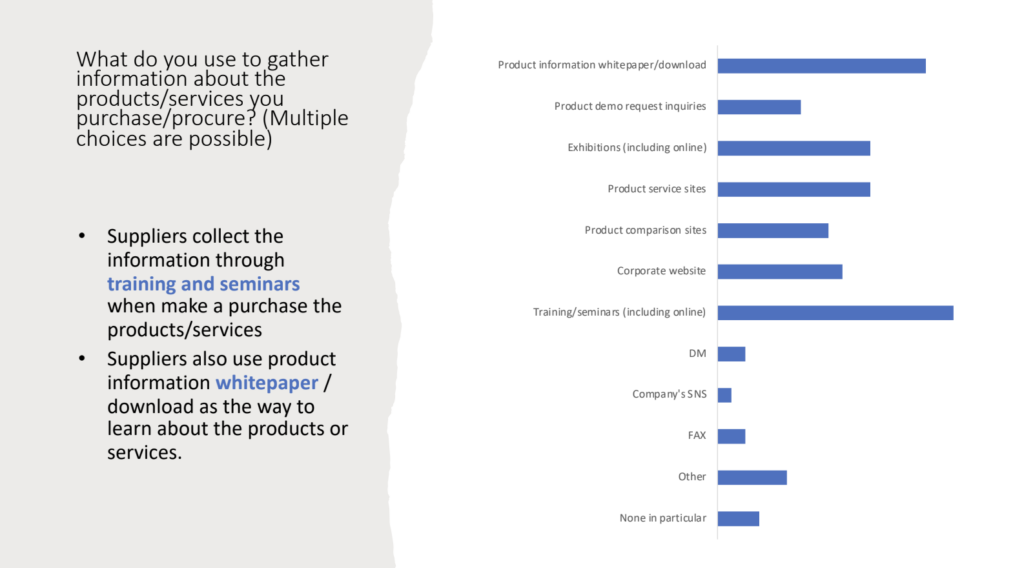
This behavior is not anecdotal. We have seen it consistently in data.
Edamame Japan conducted a survey of 280 corporate professionals who are currently or formerly worked in purchasing departments in Japan. The scope was limited to IT related products and services, including software, SaaS, and IT infrastructure.
When asked how they gather information during the purchasing and procurement process, the results were clear.
Whitepapers and downloadable product documentation ranked among the most commonly used sources. Training sessions and seminars, including online formats, ranked even higher. In contrast, direct inquiries, social media, and outbound communication played a far smaller role.
This shows how Japanese buyers actually reduce risk. They rely on structured materials that can be reviewed, shared internally, and discussed across teams. Whitepapers are not optional content. They are part of the evaluation infrastructure.
If a document cannot support internal explanation or training style understanding, it simply stops being used, regardless of how strong the product itself may be.
*If you are interested in the full survey results and deeper breakdowns by role and buying stage, please contact Edamame Japan for details.
A Realistic Whitepaper Workflow for Japan
A workable process looks boring, but it works.
First, be clear about why the whitepaper exists in Japan. Not the global objective. The Japanese one.
In most cases, it is not about broad thought leadership. It is a document meant to be downloaded, circulated, or handed to sales as a follow-up reference for prospects who are still cold.
Second, rewrite based on Japanese decision logic. This may change the structure significantly.
Third, conduct a quality review by people who understand the market, not just the language.
Finally, plan distribution before publication. Who will share it. How it will be used. Where it fits in the sales process.
Skipping any step weakens the whole effort.
Conclusion
In Japan, white papers are not considered content. They are trust infrastructure.
Non-Japanese tech companies that treat them as translation tasks struggle quietly. Those who reframe them as market-entry tools gain long-term leverage.
The difference is not language. It is respect for how trust is built.
And once you align with that, Japan stops being mysterious. It becomes methodical.
About Edamame Japan
Edamame Japan helps non-Japanese B2B tech companies create white papers that work within Japanese organizations.
Before we localize anything, we start by deeply understanding the product or service itself, the target users, and the real situations in which that service is evaluated and used. We look at how the service fits into daily operations, internal explanations, and decision-making processes in Japan.
Only after that do we work on structure, logic, terminology, and tone. Localization without this understanding is just surface-level accuracy. It may read correctly, but it rarely earns trust.
If your whitepapers are translated but not circulated, downloaded but not discussed, the issue is usually not language. It is misaligned with how Japanese buyers actually evaluate services.
If you want a practical review of whether your documents support real usage and internal consensus in Japan, feel free to contact us.
