
Does 6sense Work in Japan? What We Learned Running ABM Ads for Global B2B Software Companies
Is your HQ already using 6sense, and now asking whether to run it for Japan too?
Let me give you the conclusion first. 6sense can reach most of your target accounts in Japan. But in our campaigns it cost about three times more per impression than Japanese DSPs, and it rarely brought leads by itself. It also needs some setup for Japan, or a large part of the budget goes to universities and to websites you would never pick.
From 2023 to 2025, we ran 6sense advertising in Japan for global B2B software companies, with more than USD 100,000 in media. In this post, I share the average numbers across those campaigns (company names removed), what went wrong at the start, what we changed, and when I would use a Japanese DSP instead.
How 6sense IP targeting works in Japan
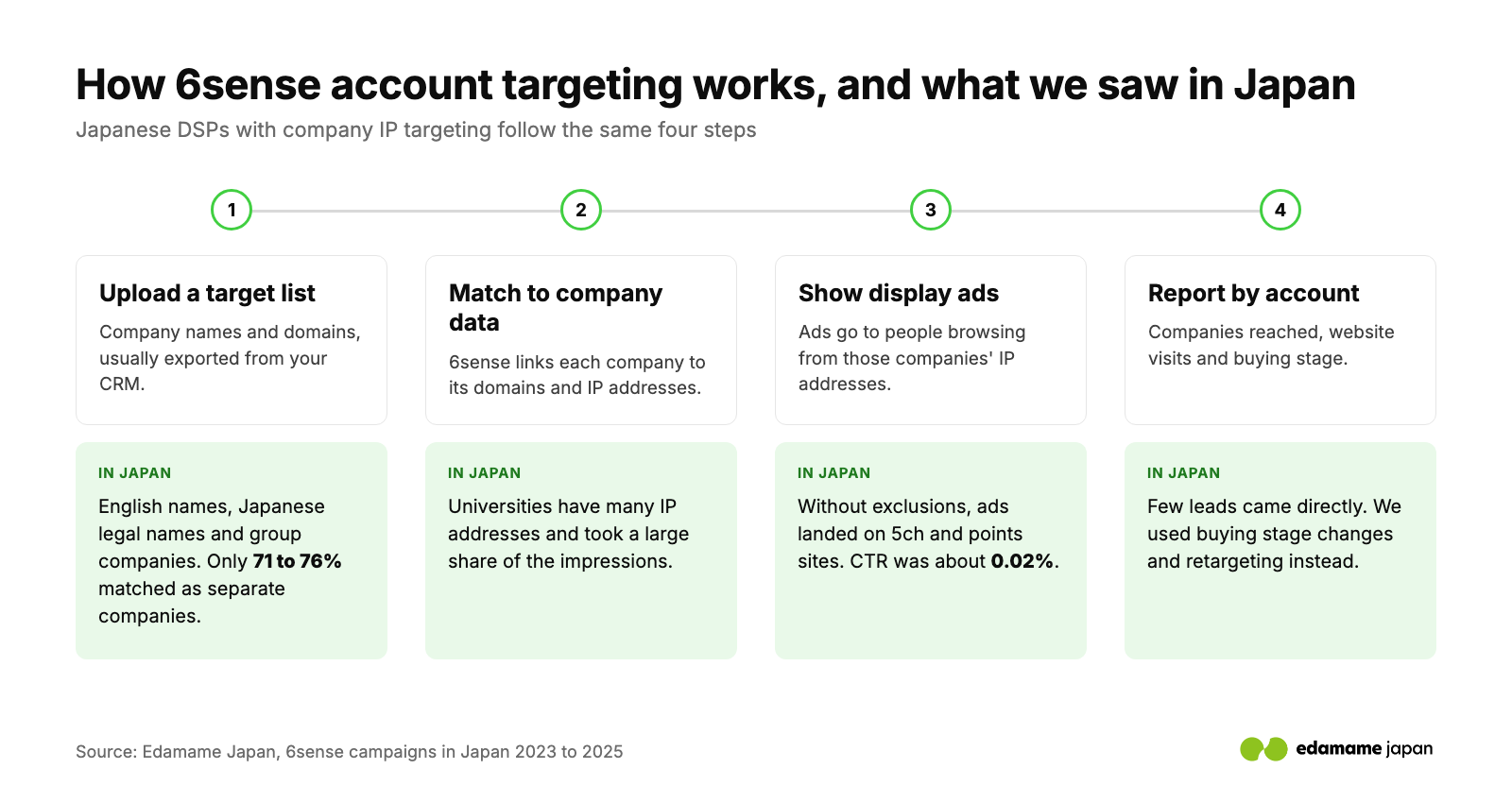
6sense ads are IP-based account targeting. You upload a list of your target companies in Japan, 6sense matches each company to its own company database, and then it shows display ads to people browsing from those companies' IP addresses.
Reporting is by account. You can see which Japanese companies saw the ads, which ones clicked or visited your website, and which buying stage 6sense thinks each company is in (Target, Awareness, Consideration, Decision or Purchase).
In our campaigns, the ads appeared on Japanese websites, from business media to anonymous forums, so where the ads run needs checking from the first week (more on this below).
Some Japanese DSPs, such as Logicad, also offer company IP targeting. You give them the same kind of list, they match it to their own IP data and show the ads on Japanese websites. So the mechanism is close to 6sense, but the company data, the websites and the price are different.
Our 6sense numbers in Japan
These are the averages across our 6sense campaigns in Japan from 2023 to 2025, for the periods where we have full data. All amounts are in USD.
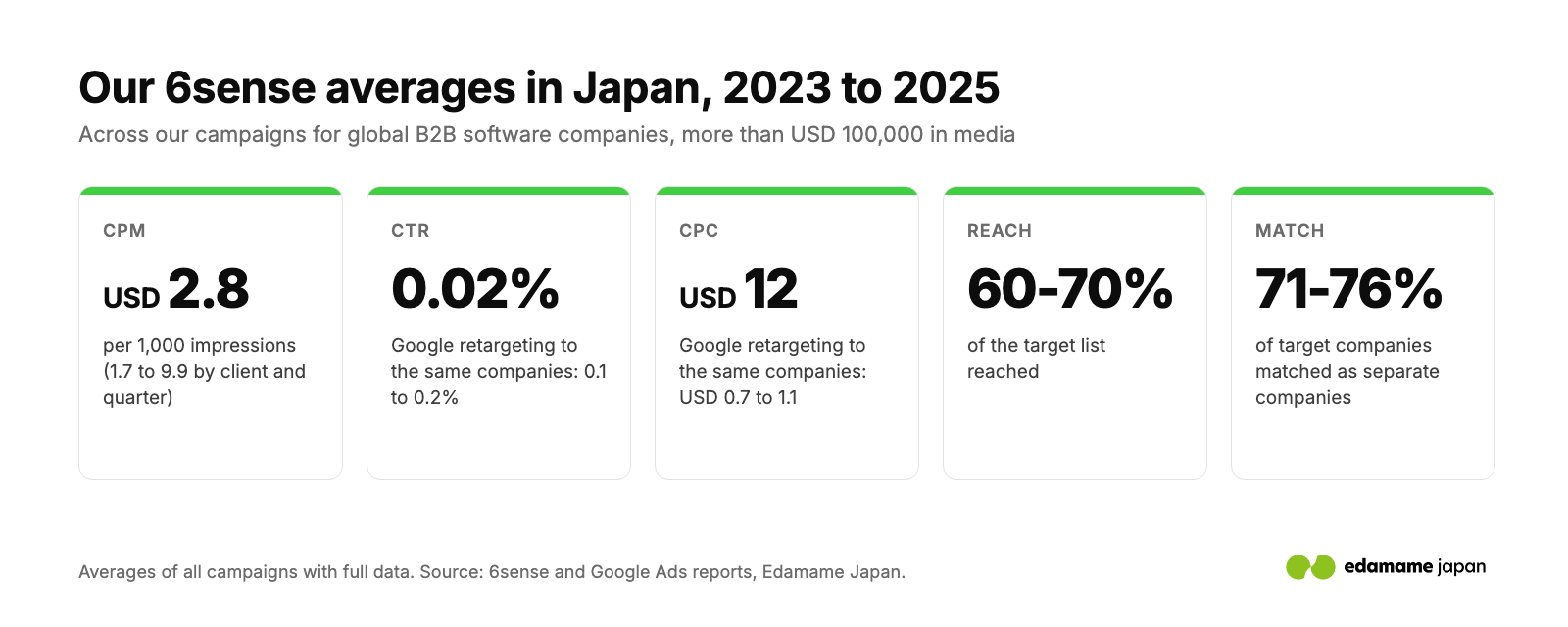
- CPM (cost per 1,000 impressions): 2.8 on average (from 1.7 to 9.9, depending on the client and the quarter)
- CTR: 0.02%
- CPC: about 12
- Share of the target list reached: 60 to 70%
- Target companies matched as separate companies: 71 to 76%
I will be honest about the CTR. 0.02% is low even for display ads. In the same period, Google display retargeting to the same companies got 0.1 to 0.2% CTR, at about USD 0.7 to 1.1 per click.
Leads were also few. In 2023, when the 6sense ads went to pages without a form, 6sense brought no leads at all. In the year one client spent more than USD 70,000 on 6sense, we counted 10 conversions.
What 6sense did well was bringing target companies to the website. For one client in the first half of 2023, 669 of the 3,160 target companies that 6sense could reach came to the website after seeing or clicking the ads, and 839 showed more website activity than before. However, when we looked at the list, many of them were universities. I will come back to this below.
6sense compared with Japanese DSPs
In 2025, one client moved the same target list from 6sense to a Japanese DSP called Admatrix, and then to Logicad. So we could compare the three on the same companies.
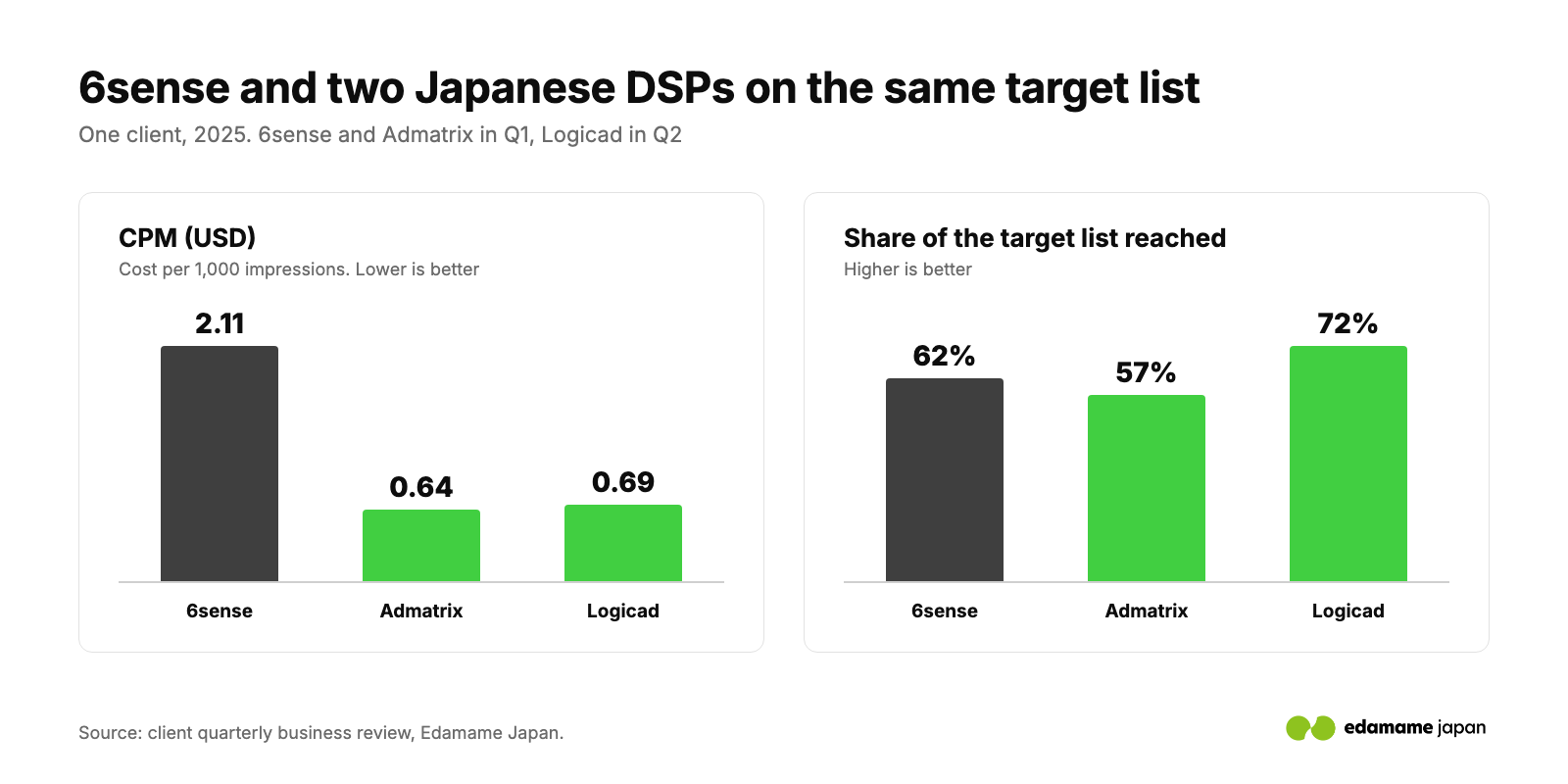
| CPM (USD) | Share of the target list reached | |
|---|---|---|
| 6sense (Q1 2025) | 2.11 | 62% |
| Admatrix (Q1 2025) | 0.64 | 57% |
| Logicad (Q2 2025) | 0.69 | 72% |
Logicad reached more of the list at about a third of the 6sense price. After this, the client moved its display budget for target accounts to Logicad, and its plan for 2026 uses 6sense for reporting and for alerting SDRs when a target company shows interest.
Where our first 6sense campaigns in Japan went wrong
These are the main problems we ran into.
Universities took a large share of the impressions
Our first campaigns showed far more ads to universities than to companies. Even small Japanese universities looked more active than large enterprises.
We asked 6sense about it. Their answer was that universities usually have many more IP addresses than company offices, so display campaigns tend to serve more impressions to them. They suggested adding persona targeting, which adds USD 4 to the CPM.
Ads showed up on 5ch and points sites
When we checked the placements, many ads were on 5ch (a large anonymous forum in Japan), game sites and points sites. These are not places where people at our target companies research business software.
Company names did not match cleanly
Japanese companies have an English name, a Japanese legal name, and often many group companies. When we uploaded the same list of 3,406 companies once with English names and once with Japanese names, 6sense showed 97% and 95% matched.
However, about 800 of those were duplicates, where two or more rows on our list matched the same company in 6sense. The number of separate companies was 2,507 with English names and 2,417 with Japanese names, so 71 to 74%. (On a different list a year earlier, it was 76%.)
The reports had the same problem. We saw the same company twice (once in English and once in Japanese), home internet providers, and one "company" called just 株式会社, which is the Japanese word for "Inc."
High CPC made the retargeting pool small
With CPC around USD 12 (and much higher in some quarters), 6sense brought few clicks. That also meant few visitors for Google and Yahoo! JAPAN to retarget later, which was part of our plan.
We could not see 6sense in the CRM
At one client, we could not find 6sense visits in Salesforce, and we suspected the UTM parameters were being dropped when the data came in. So we used the change in 6sense buying stages of the target companies as the main measure, instead of leads.
What we do when a client runs 6sense in Japan
Most of the problems above can be fixed with the right setup and weekly checks, and this is the part of the work we do for clients.
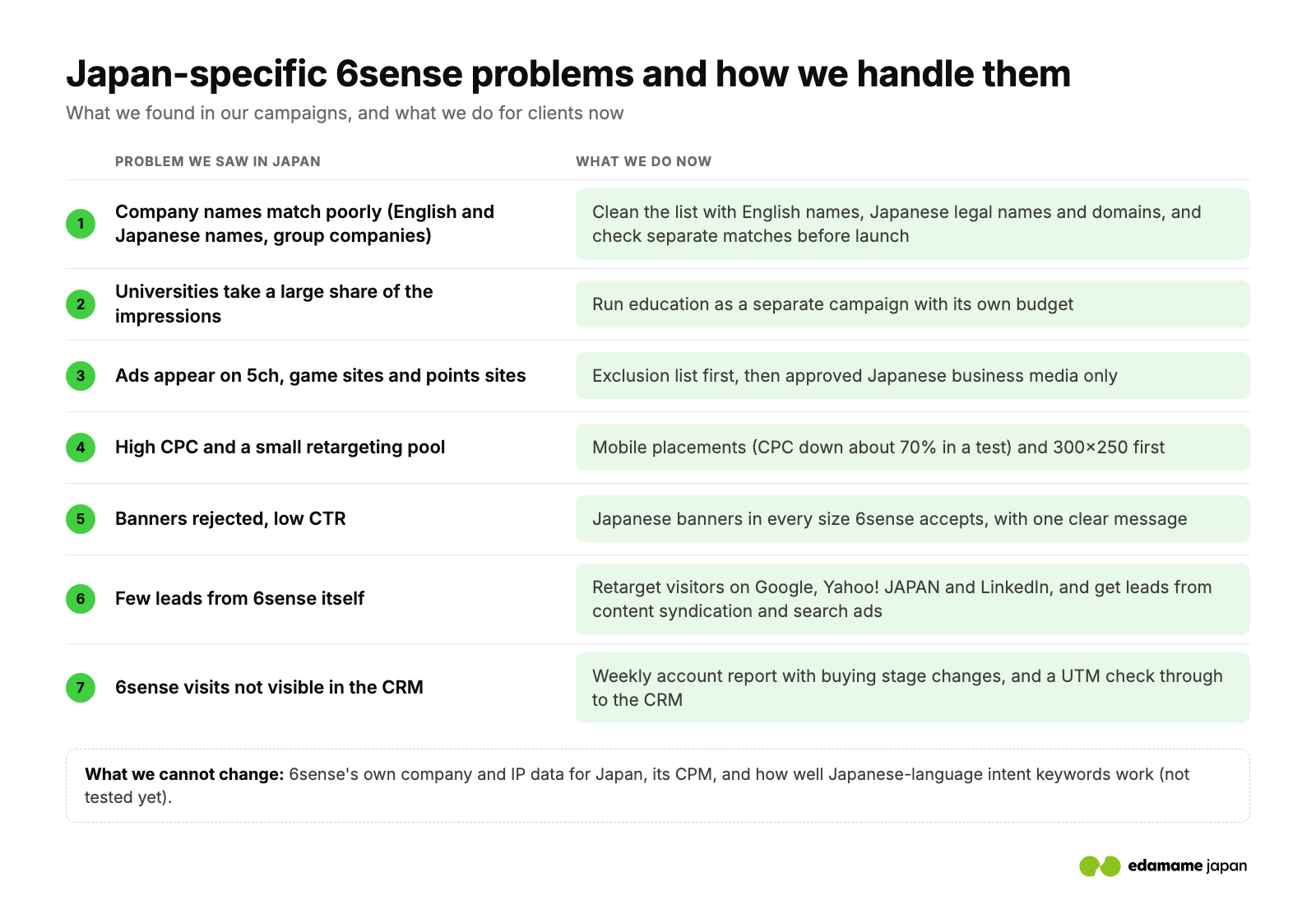
1. Prepare the target list for Japan
We clean the list before uploading it, with English names, Japanese legal names and domains, and with group companies sorted out. After uploading, we check how many separate companies matched, since the total on the screen includes duplicates.
2. Run universities as a separate campaign
We split each segment into education and non-education and run them as two campaigns with their own budgets. (6sense told us one campaign cannot have two budgets.) When we did this, reach and performance were much better, and the budget went to the companies we actually wanted.
3. Control where the ads appear
We started with an exclusion list (5ch, game sites, points sites) and later moved to a list of approved Japanese business media. Our mobile placements ended up mostly on sites like MSN and Toyo Keizai Online.
4. Lower the CPC with mobile and common sizes
In one test, moving 6sense ads to mobile cut the CPC by about 70% and raised CTR by almost 2.5 times. 300x250 had the most inventory in our campaigns, so we always make that size.
5. Make Japanese banners in every size 6sense accepts
6sense rejects sizes it does not support (we had banners rejected for 960x1200), so we make Japanese banners in all accepted sizes. In our campaigns, simple banners with one clear message got higher CTR on 6sense, and report or whitepaper banners did better later in retargeting.
6. Retarget, and get leads from other channels
We use 6sense to reach the companies, then retarget the people who visited with Google display, Yahoo! JAPAN display and LinkedIn. Leads mostly come from other channels, such as content syndication with Japanese publishers and search ads. (In 2023, most of one client's Japan leads came from content syndication.)
7. Report by account every week
We share a weekly account-level dashboard in Looker Studio, with reached companies, engagement and buying stage changes. We also check that the UTM parameters actually reach the CRM.
8. Compare with a Japanese DSP on the same list
If the goal is reach on a Japan list, we test a Japanese DSP on the same list and compare cost and reach, as in the table above.
There are also things we cannot change, such as 6sense's company and IP data for Japan and its CPM. We have also only used English intent keywords so far (for example "cloud computing"), so I don't know yet how well 6sense picks up research done in Japanese.
When I would use 6sense in Japan
My impression is that 6sense makes sense in Japan in these cases:
- HQ already pays for 6sense and wants Japan in the same report as the other countries
- You use buying stages and intent signals to tell SDRs which companies to call
- Your target list is mostly large enterprises with their own offices and IP ranges
If the main goal is to show ads to a Japan target list at a lower cost, I would use a Japanese DSP, or run both and keep 6sense for reporting. Either way, reach alone will not bring leads in Japan, so please plan the retargeting and the Japanese content from the start. Our guide to B2B lead generation in Japan covers the other channels.
Frequently asked questions
How does 6sense IP targeting work in Japan?
You upload a list of your target companies in Japan, and 6sense matches each one to its company database, including domains and IP addresses. It then shows display ads to people browsing from those IP addresses. In our campaigns, three things needed setup specific to Japan: matching English and Japanese company names, keeping universities from taking the impressions, and controlling which Japanese websites the ads appear on.
Does 6sense work in Japan?
Yes, for reaching target accounts. In our campaigns, 6sense reached 60 to 70% of the target list. However, CTR was about 0.02%, the CPM was about three times that of Japanese DSPs, and it rarely brought leads by itself.
How much does 6sense advertising cost in Japan?
In our campaigns from 2023 to 2025, the media cost averaged USD 2.8 CPM and about USD 12 per click. This is media only. In our case, the client held the 6sense license.
Why does 6sense show so many ads to universities in Japan?
Universities have many more IP addresses than company offices, so IP-based display campaigns serve more impressions to them. 6sense confirmed this to us. We run education as a separate campaign with its own budget.
What match rate should we expect for a Japanese target list?
On our lists, 6sense showed 95 to 97% matched, but after removing duplicates, 71 to 76% of the companies matched as separate companies. English names matched slightly better than Japanese names.
Is a Japanese DSP better than 6sense for ABM in Japan?
For reach at a lower cost, it was in our comparison. On the same target list, Logicad reached 72% of the companies at USD 0.69 CPM, and 6sense reached 62% at USD 2.11. 6sense is still useful if HQ wants Japan in the same report, and for buying stage signals.
Can 6sense generate leads in Japan?
Rarely by itself. In one year with more than USD 70,000 in 6sense media, we counted 10 conversions. Leads came mostly from retargeting, content syndication and search ads.
How we can help
We run account-based advertising in Japan for foreign B2B tech companies, with 6sense and with Japanese DSPs, and we plan the retargeting, content syndication and search ads around it. You can see more of our work in our case studies.
If your HQ uses 6sense and you are thinking about Japan, please send me the size of your target list and what you sell. I will tell you how we would set it up, and whether a Japanese DSP could do the same job for less.

Pingback: Does Content Syndication Work in Japan? - Edamame Japan