
Does Content Syndication Work in Japan? What Our Lead Data Shows

Is your HQ asking whether to run content syndication in Japan? Or did your last campaign bring leads that nobody could reach?
Let me give you the conclusion first. Content syndication works in Japan for getting leads. Japanese publishers deliver the number of leads they promise, usually within about two months. The problems start after the download. Most people who download a white paper in Japan are not ready to talk to sales yet, so if the plan is one call from an SDR, the leads will look bad.
Since 2022, we have run content syndication in Japan for global B2B software and security vendors, with Japanese publishers and with global vendors that also sell Japan leads. In this post, I share what it costs, what we got, why many leads go quiet, and what we change. Company names are removed and the numbers are rounded.
We first wrote about this topic in 2023. This is the updated version, with our own data.
Summary
- Content syndication in Japan brings leads fast. In our campaigns, 150 to 300 leads in about two months was normal, and the publishers delivered the numbers they promised.
- List prices at Japanese publishers run from about JPY 4,000 to JPY 26,000 per lead, depending on how narrow your target is. Across our campaigns from 2022 to 2026, we paid about USD 55 to 200 per lead.
- Cheap leads from global vendors had a catch. In one campaign, about 7 in 10 leads came from foreign-affiliated companies in Japan.
- After downloading a white paper, only about 1 in 10 readers contacts the vendor (ITmedia's reader survey). Syndication works when the leads go into nurture in Japanese, with emails, webinars and new content over several months. One SDR call is not enough.
How content syndication works in Japan
You give a Japanese B2B media company your content, such as a white paper, a case study or a webinar recording. The publisher shows it to its registered members on its websites and in its emails. When a member downloads it, you receive their name, company, department and job title as a lead. You pay per lead, usually for a guaranteed number of leads.
The main publishers for B2B tech in Japan are ITmedia (TechTarget Japan, Keyman's Net, @IT, ITmedia Enterprise), Nikkei BP (Nikkei xTECH, Nikkei Business), Mynavi (TECH+), ZDNET Japan and Business+IT. Some global syndication vendors also sell leads in Japan.
A few things work differently from the US or Europe:
- Leads come with Japanese departments and ranks (情報システム部 部長, for example), so in practice you target a company list plus department and job level.
- The price per lead depends on how much of the publisher's membership matches your target. The narrower the target, the higher the price.
- The content has to be in Japanese. Translated content gets fewer downloads (numbers below).
How much content syndication costs in Japan
These are list prices from the publishers' own media guides, plus what we actually paid.
| Publisher | Price per lead | Minimum order | Notes |
|---|---|---|---|
| ITmedia | JPY 4,000 to 26,000 | JPY 500,000 per campaign (includes a JPY 100,000 base fee) | Price depends on target share and product category. Under 10% target share: on request. About two months per campaign. Guide dated October 2025 |
| Nikkei BP | From JPY 15,000 | 40 leads (JPY 600,000) | Guide dated January 2026 |
| Another Japanese lead platform | USD 160 to 200 | About USD 10,000 | Quote we received in 2025 |
At about JPY 150 to the dollar, ITmedia's range is about USD 27 to 175 per lead.
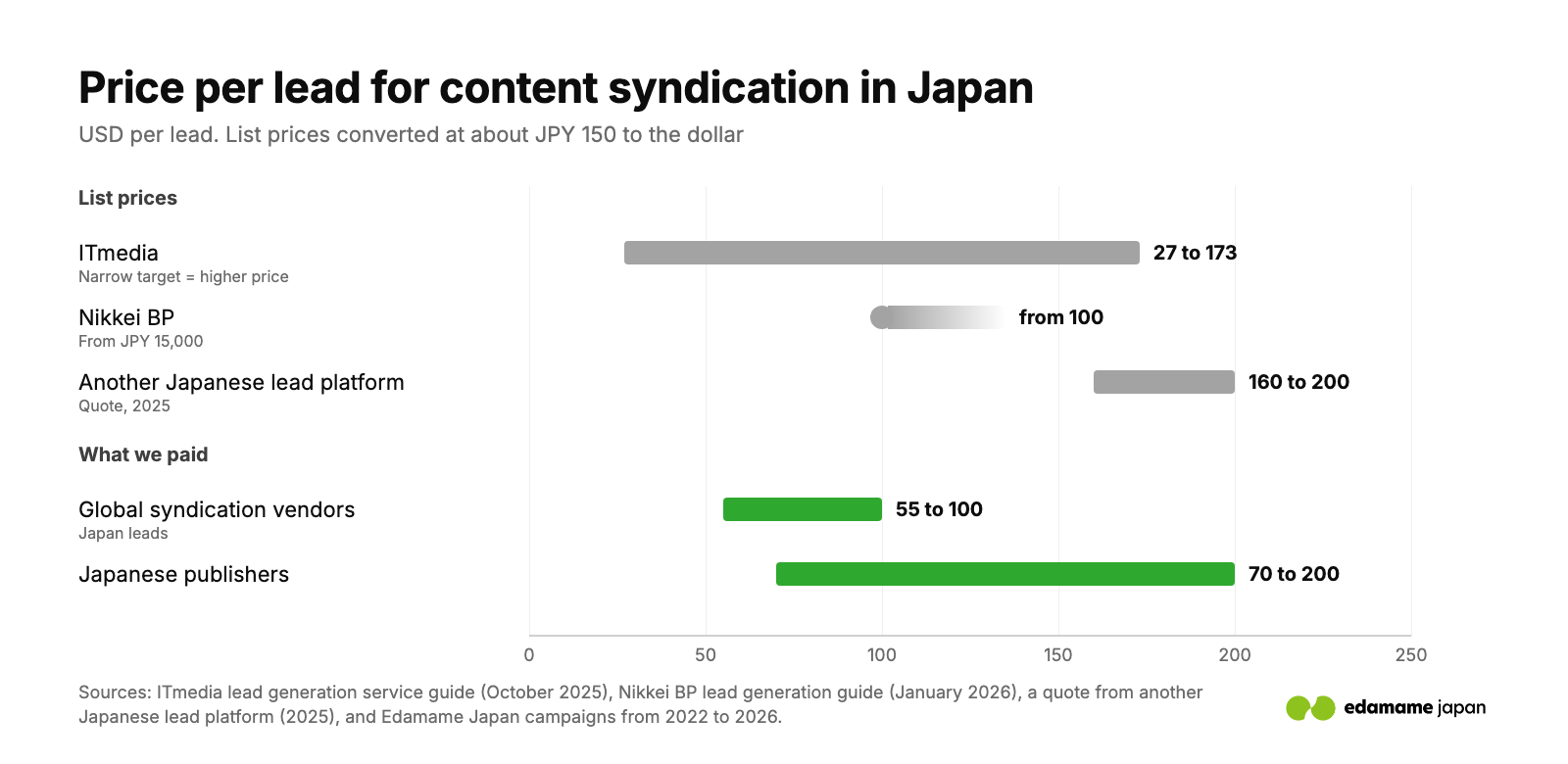
Across our campaigns from 2022 to 2026, we paid about USD 55 to 200 per lead. The global vendors that sell Japan leads were at the low end, at about USD 55 to 100. Japanese publishers were about USD 70 to 200, depending on how narrow the target was.
What we got from content syndication in Japan
- Speed: one campaign brought close to 300 leads in about a month and a half. Most campaigns brought 150 to 300 leads in about two months.
- Delivery: in one year-long program with nine publishers, the campaigns we tracked to the end delivered a little more than the publishers had promised.
- Target accounts: in a recent campaign aimed at a client's must-win account list, close to half of the new contacts came from that list.
- Budget: in 2026, one client cut its Japan digital budget by almost half. New contacts and MQLs fell by about 30%, and syndication and on-demand webinars were the channels that kept it from falling further.
However, the one concern I have is where cheap leads come from. In one campaign with a global vendor, about 7 in 10 leads were from foreign-affiliated companies based in Japan. If your target is Japanese companies, that matters a lot. Limiting the campaign to our target accounts would have more than doubled the price per lead. So when you compare prices, check who the leads are.
When I looked back at our work in early 2024, I wrote down the global vendor campaigns as a failure, and the program with Japanese publishers as a success on cost.
Why many content syndication leads in Japan go quiet
Most complaints about syndication in Japan are about this part: the leads are bad, or nobody answers. From what we have seen, there are four reasons. I will explain each one.
Most readers are not ready to talk to sales
ITmedia asked white paper readers what they did after downloading (December 2020, 482 answers, multiple choice).
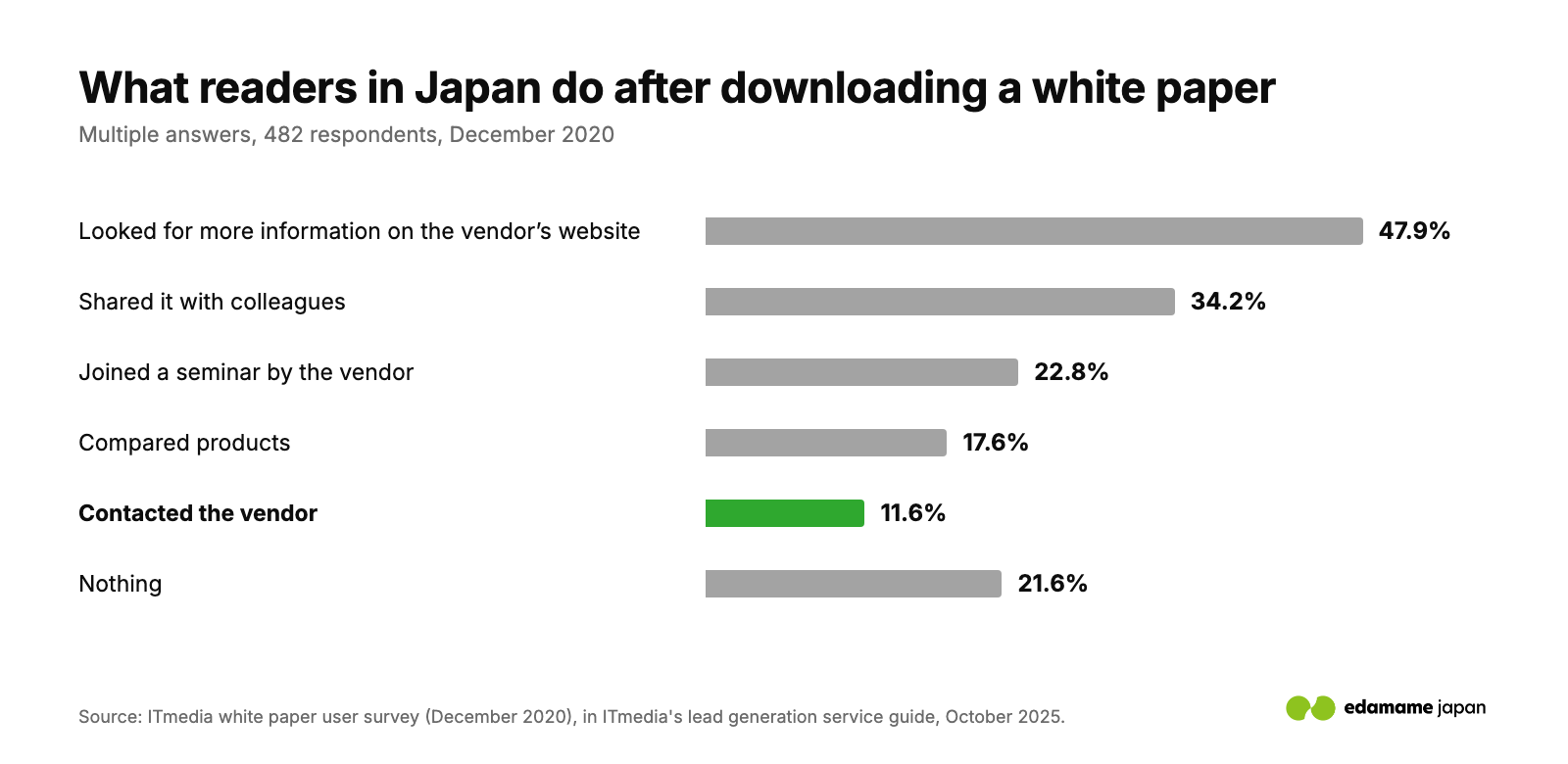
- Looked for more information on the vendor's website: 47.9%
- Shared it with colleagues: 34.2%
- Joined a seminar by the vendor: 22.8%
- Compared products: 17.6%
- Contacted the vendor: 11.6%
- Nothing: 21.6%
So about 1 in 10 contacts the vendor. Many more share it inside their company and keep reading. My impression is that the person who downloads is often collecting information for a discussion inside their company.
One call, then the lead is closed
We have seen the same channel give two very different results.
One client's SDR team called each lead within a few days, once, and then closed it. Their conclusion was that the leads were poor, and in 2026 they told us the syndication leads were not answering their calls or emails.
Another client put every lead into marketing automation, sent new content and webinar invitations for months, and sales stepped in when the account showed buying signals. That client has kept using syndication in Japan for years.
From my experience, content syndication does fail sometimes, especially when nobody follows up even once. Syndication is hard, I know. But it has to come with nurture.
Also, I do not recommend calling every lead. Phone follow-up after a download is not popular in Japan, and it can lead to complaints.
Nurture rules drop people too early
One client's rule-based nurture program stopped emailing anyone who had not reacted in the last 18 months. In a full year, it created no opportunities. Emails built on topics buyers cared about at that moment did create opportunities.
B2B buying takes a long time, so a rule that removes people after 18 months can cut them off right when some of them start to move.
Old leads sit unused in the CRM
At one client, thousands of older leads from target accounts were sitting in the CRM with no contact. They are now being invited to webinars again.
Some leads do come back later. In one half-year in 2026, a few of a client's MQLs had first come in through syndication and returned later through search.
What we changed in a campaign that started at zero
Here is a recent example. In 2026, we ran a campaign for a software vendor on a Japanese lead platform. After the first two weeks, we had zero qualified leads.
The publisher's emails were working. The click-through rate was 0.82%, and the platform's usual range is 0.6 to 1%. But almost nobody downloaded, against a usual download rate of 3 to 5% on that platform. So people were interested enough to click, and we were losing them on the landing page.
We changed four things:
- We rewrote the title and description in Japanese around one concrete problem and a number, instead of a general topic.
- We removed three detailed questions from the form and kept one simple question about timing.
- We widened the job levels from manager and above to practitioners at the same companies. For a technical topic, the engineers often feel the problem first.
- We added a Japanese customer case study.
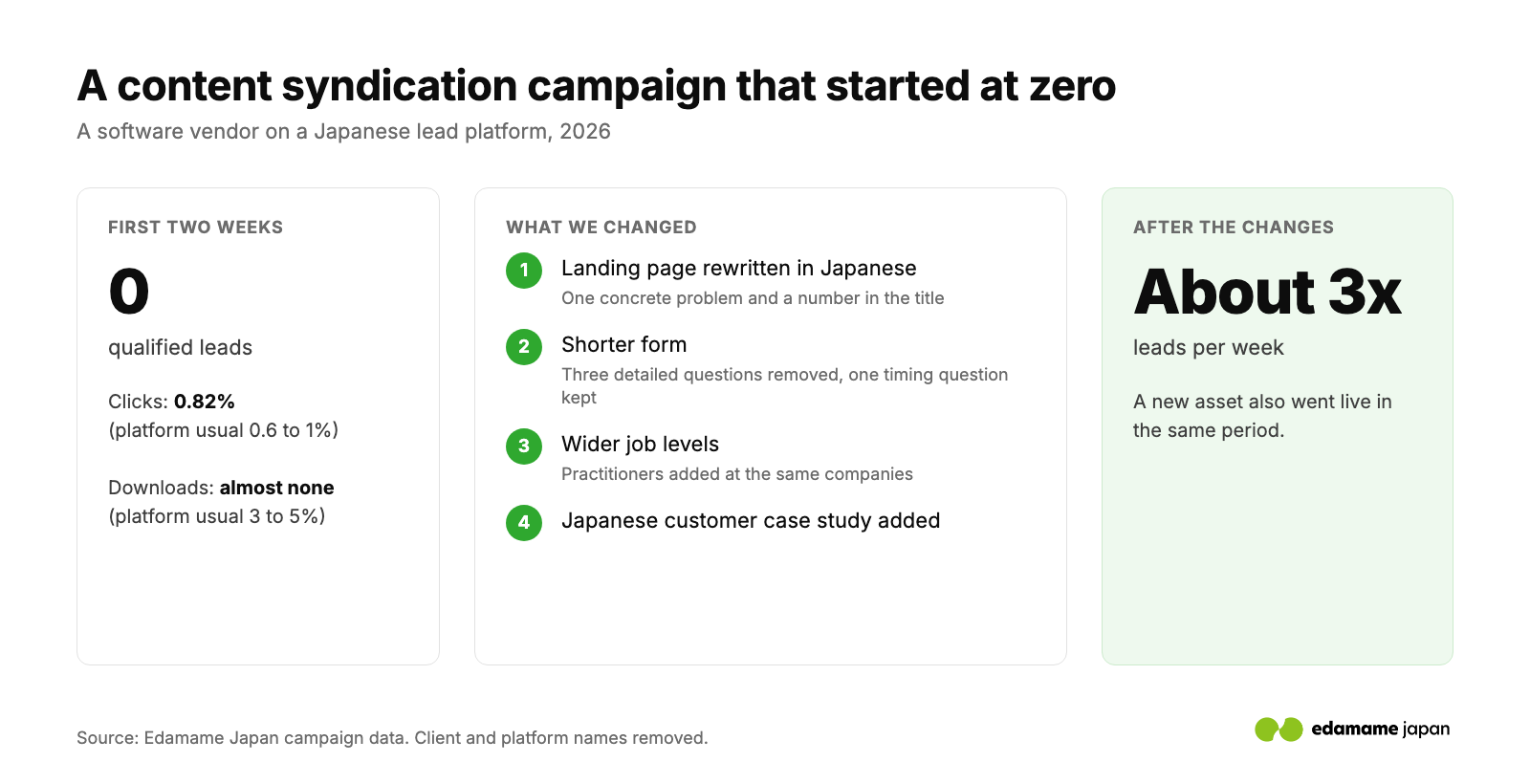
After these changes, plus a new asset, the number of leads per week went up about three times.
This matches what we saw in 2023. Content written in Japanese converted much better than translated content (white papers 1.56% vs. 0.89%, case studies 5.42% vs. 3.89%).
How we run content syndication in Japan now
1. Choose the publisher by its members
Check what share of the publisher's members are in your target departments and company sizes. That share decides both the price and the quality. Ask for the member breakdown before you sign.
2. Use content written for Japanese buyers
A Japanese case study, a checklist or a report with numbers works best for us. A translated product brochure gets few downloads.
3. Keep the landing page and form simple
One clear problem in the title, a short description, and a short form. Ask detailed questions later, in nurture.
4. Target the company list, departments and practitioners
Use your target account list with departments and job levels, and include practitioners when the topic is technical.
5. Plan the follow-up before buying leads
Before the campaign starts, prepare Japanese nurture emails, a webinar to invite leads to, and new content for the next three to six months. We do not call every lead.
6. Check every lead file
Check how many leads are from Japanese companies and how many from foreign-affiliated ones, remove duplicates and existing customers, and check titles. Use an exclusion list from the start.
7. Measure over six to twelve months
Look at MQLs and opportunities from these leads over six to twelve months. The lead count in the first month tells you only that the publisher delivered.
When I would not recommend content syndication in Japan
- If nobody can follow up in Japanese for the next three to six months (emails, webinars, new content).
- If HQ expects sales-qualified leads within the first month.
- If your target is very narrow. The price per lead rises as the match drops, ITmedia does not publish a price below 10%, and account-based display ads may be a better start (see our post on 6sense in Japan).
- If the only content you have is a translated product brochure.
Frequently asked questions
Does content syndication work in Japan?
Yes, for getting leads. In our campaigns from 2022 to 2026, Japanese publishers delivered the leads they promised, usually 150 to 300 per campaign in about two months. Whether those leads turn into opportunities depends on the nurture after the download.
How much does content syndication cost in Japan?
List prices at ITmedia run from JPY 4,000 to 26,000 per lead depending on how narrow the target is, with a minimum of JPY 500,000 per campaign (October 2025). Nikkei BP starts at JPY 15,000 per lead with a 40-lead minimum (January 2026). Across our campaigns, we paid about USD 55 to 200 per lead.
Which publishers offer content syndication in Japan?
For B2B tech, the main ones are ITmedia (TechTarget Japan, Keyman's Net, @IT, ITmedia Enterprise), Nikkei BP (Nikkei xTECH, Nikkei Business), Mynavi (TECH+), ZDNET Japan and Business+IT. Some global syndication vendors also sell Japan leads, usually at a lower price per lead.
Why don't content syndication leads in Japan reply to sales?
Most of them are not ready. In ITmedia's reader survey, 11.6% contacted the vendor after downloading a white paper, while 47.9% looked for more information on the vendor's website and 34.2% shared it with colleagues. They need nurture emails, webinars and new content in Japanese before a sales conversation.
Should we call content syndication leads in Japan?
We do not recommend calling every lead. Phone follow-up after a download is not popular in Japan and can lead to complaints. We put the leads into Japanese email nurture and invite them to webinars, and sales contacts the accounts that show buying signals.
Are cheap leads from global syndication vendors good for Japan?
Check who the leads are. In one of our campaigns with a global vendor, about 7 in 10 leads came from foreign-affiliated companies based in Japan. Limiting it to target accounts would have more than doubled the price per lead.
Can we use translated English content for content syndication in Japan?
You can, but it converts worse. In our data, translated white papers converted at 0.89% and white papers written in Japanese at 1.56%. For case studies, it was 3.89% vs. 5.42%.
How we can help
We run content syndication in Japan for global B2B software and security vendors: choosing the publishers, making the Japanese content and landing pages, checking every lead file, and running the nurture emails and webinars after the download. You can read more on our Japanese publisher content syndication page, and see our other work in our case studies.
For other ways to get leads in Japan, see our guide to B2B lead generation methods in Japan and our post on why white papers fail in Japan.
If you are planning content syndication in Japan, or a campaign is not bringing the leads you expected, please send me your target and the content you have. I will tell you which publishers we would use and what we would change first.
